
The Rise, Fall, and Flattening of Entertainment Empires
The History of Media Doesn't Repeat Itself... But It Does Do Remakes

Hey friends,
Today is a good day. A few weeks ago, friend and fellow Stern MBA, Connor Adams, reached out with a brilliant idea to collaborate on an essay. I jumped at the chance and the following dispatch is the result.
Don’t skip this one. It has many insights that can only come from someone who works inside the media industry like Connor. Plus, it has graphs, because Connor is a more serious individual than I am. Guaranteed you will be happier (and smarter) for reading.
Please note that this post is too long for email, and will get cut off unless you click in to view it on your web browser. As usual, don’t forget to like and subscribe. There is a lot more great content coming soon.


Introduction
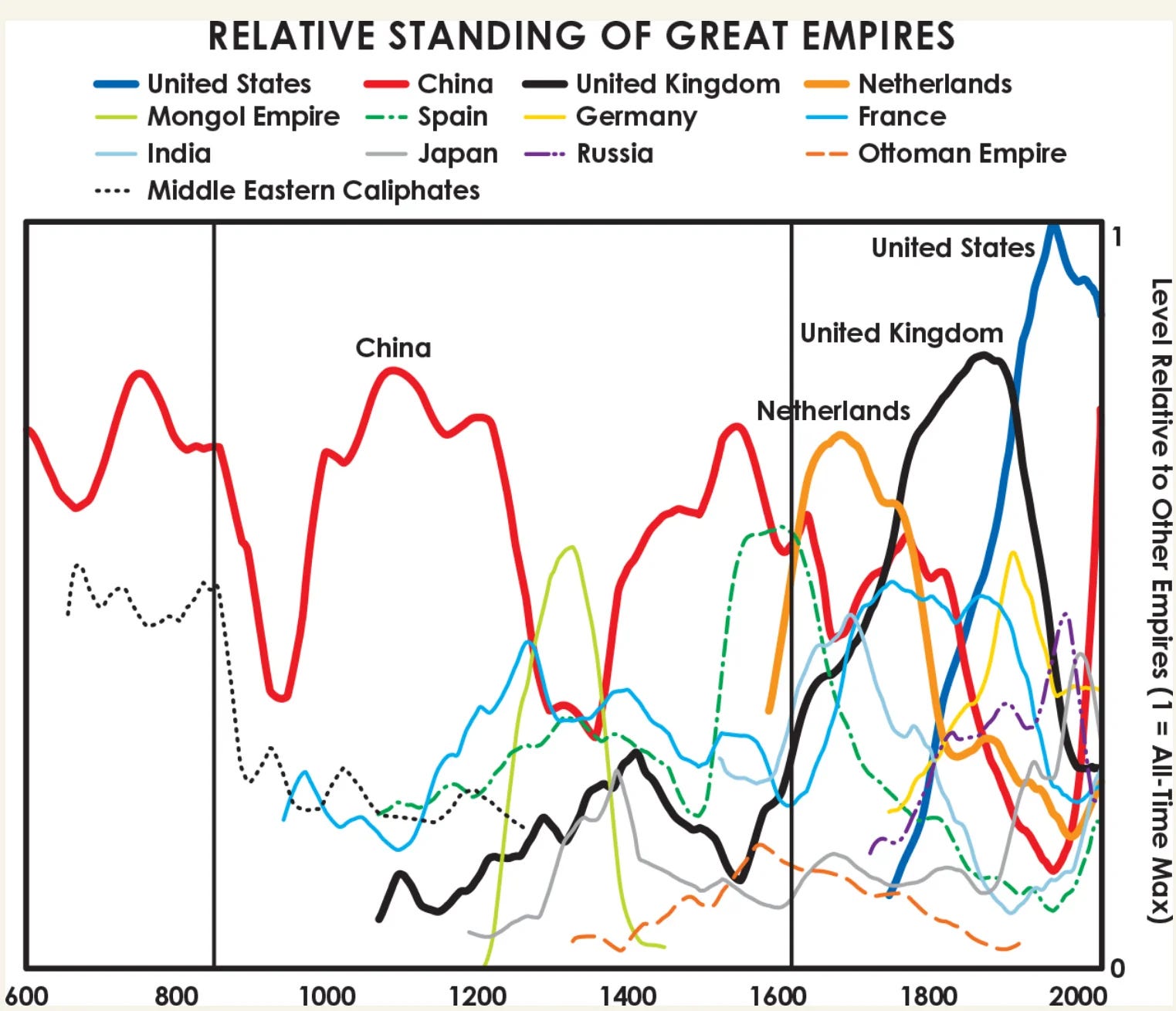
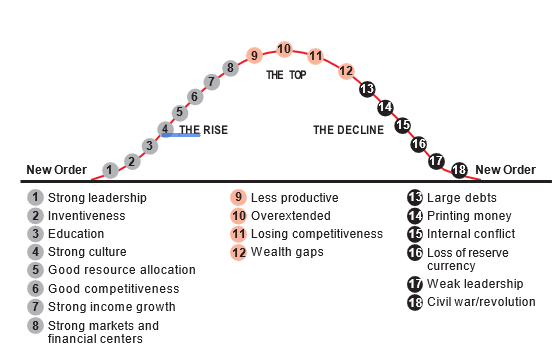
I (Connor) was recently reading Ray Dalio’s How Countries Go Broke, a spiritual sequel to The Changing World Order, where Dalio organizes the history of various empires into succinct and identifiable cycles. The basic idea of these books is that, across centuries, the political and economic power of territories tends to concentrate, peak, fragment, and then decline. The Spanish empire of gold gave way to the Dutch shipbuilding empire, gave way to the British, who gave way to the Americans and so on and so on.
As someone who works in media, that framework reminded me of the entertainment landscape of today in a more narrative way than the typical lifecycle of an industry found in business textbooks. The giants and mediums I grew up with and saw as eternal are losing dominance, while insurgents rise alongside them. Being a movie star is no longer the equivalent of royalty. The dream of kids today is to be on YouTube rather than Comedy Central or CBS. There are countless other common anecdotes used to essentially say the same thing: what people watch now, and how they are watching, is different than what people watched then.
This piece proposes a simple idea: entertainment mediums behave like empires. They rise, peak, fragment, and flatten. The primary difference between geopolitical empire transitions and entertainment empire transitions is, of course, speed. What took centuries in geopolitics happens over decades, or less, in modern entertainment. Similarly, the entertainment hegemons of today don’t last for centuries and they often overlap rather than replace one another cleanly. Nonetheless, the dynamics that govern their trajectories still follow a distinct and recognizable pattern.
Furthermore, this paper proposes that we are living through another great cycle of transition. As the saying goes “history does not repeat itself… but it does rhyme.” Rather than frame this disruption as a novel event, our framework suggests that the current state of entertainment is a natural continuation of a long-established pattern among media empires. By laying out this pattern plainly, we aim to equip the media practitioner with a framework to better navigate the ever-changing landscape, as well as enlighten the regular consumer to the macro-shifts that are daily influencing their attention and behavior.
Scope and Limitations
A few caveats before we begin.
This framework focuses on entertainment mediums rather than information or communication systems. News media, social networks as information utilities, and messaging platforms all follow related patterns, but entertainment is our primary focus.
The timelines are approximate. This is not a scientific paper. The goal is to illustrate a pattern rather than pinpoint the exact day the radio empire fell like Rome on September 4th in 476 A.D.
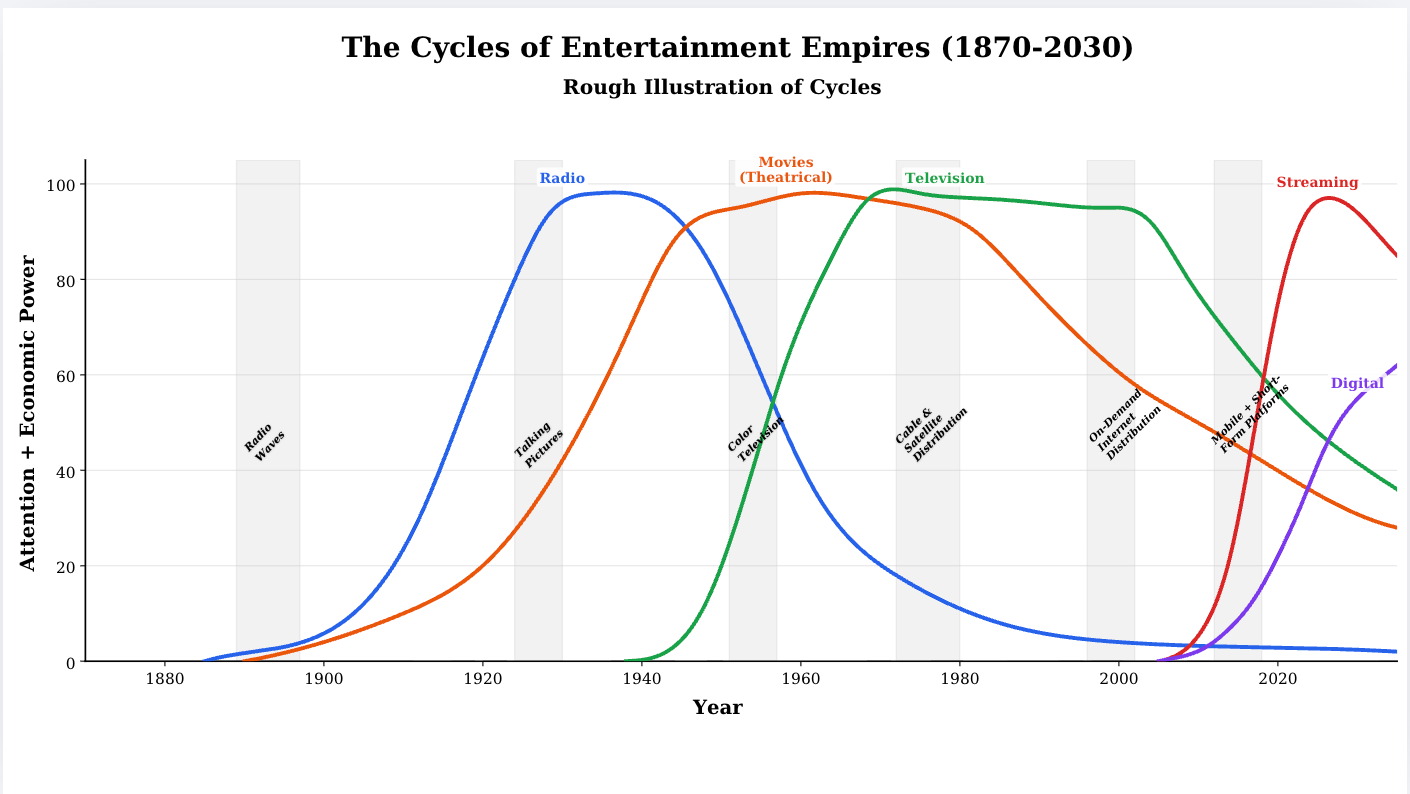
The Y-axis on any chart accompanying this piece represents something like “attention capture” or “relative dominance.” Think of it as the attention landscape: the territory these empires occupy in the collective hours and moments and mindshare of audiences. Like geographic empires that demonstrated dominance through conquered lands, entertainment empires demonstrate dominance through collective and captured attention.
We are not including literature, music, or other various “entertainment mediums” like games or amusement parks so we can keep our focus on the mediums that have been both popular and recent.
Finally, there is an important distinction between entertainment empires and geopolitical ones. Geopolitical empires that fall rarely return. The British Empire will not reconstitute itself. Entertainment empires, by contrast, can flatten rather than collapse entirely. Radio still exists. Theatrical film still exists. They just no longer dominate. They do not always disappear like the Ottomans or Austro-Hungarian Empire.
Lastly, the utility of metaphors is that they frame our understanding in a focused, yet incomplete manner; so we realize that the metaphor of “entertainment mediums as empires” has natural limitations. What our framework tries to capture is the business-related dynamics and how that drives the palpable, but often unarticulated, fluctuations felt by consumers in the entertainment space. In acknowledging these limits, we aim to illuminate how structures of attention are quietly at work, without mistaking it for the whole terrain of cultural experience.
The Seven-Stage Cycle
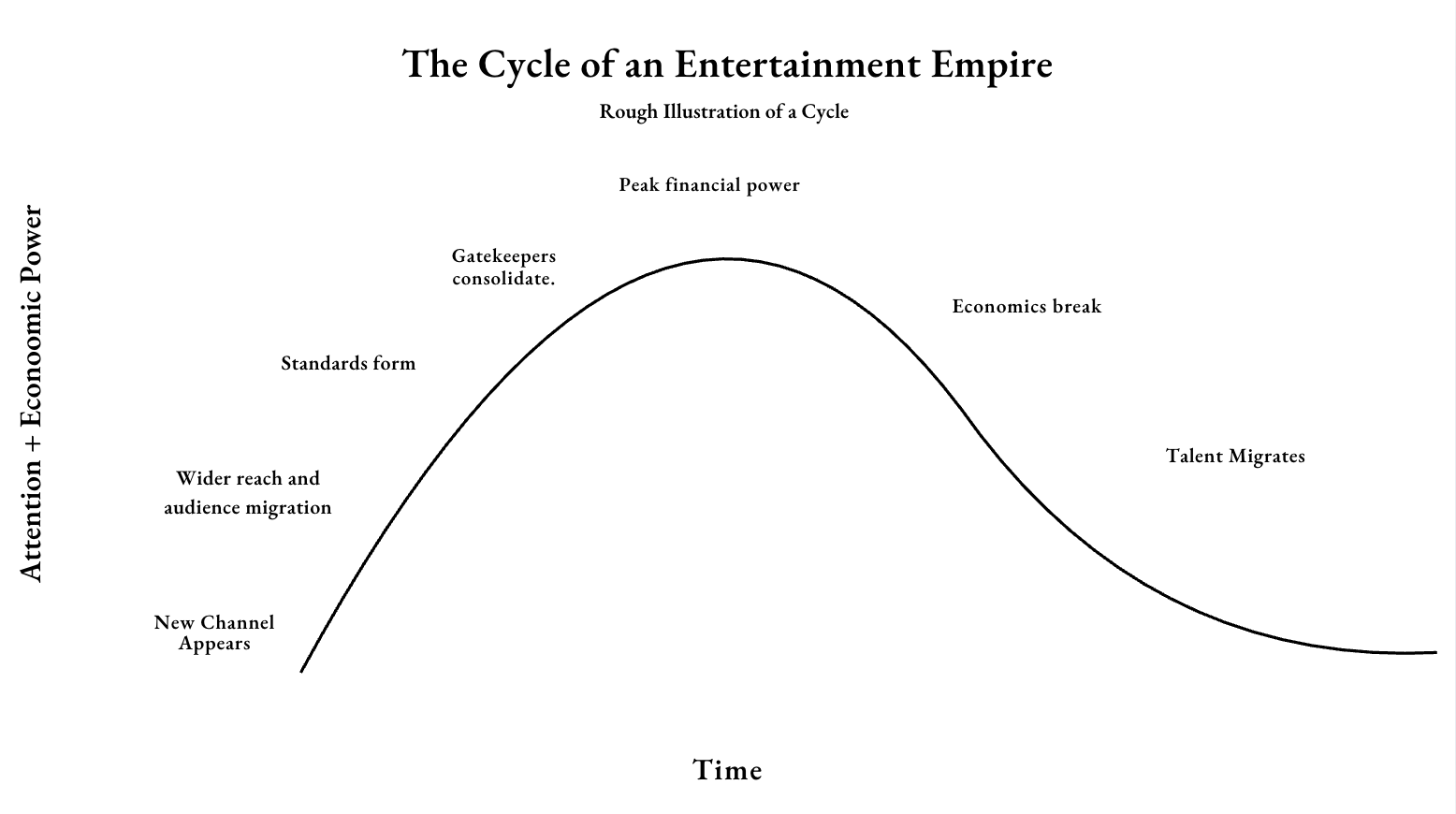
Each medium examined here follows a similar structural arc, which will look familiar to fans of Michael Porter. The stages are:
Stage 1: New channel appears. A breakthrough technology enables a new form of content creation or distribution. Radio waves. Recorded film. Broadcast signals. Internet protocols. The technology creates possibility, excitement, and a new way for artists to reach an audience.
Stage 2: Wider reach and audience migration. The new channel attracts audiences. Time and attention shifts. Advertisers and performers recognize the new channel and begin investing resources toward it. Audiences and fandoms of all sizes are born, with a shared identity shaped by shared habits and rituals.
Stage 3: Standards and formats form. Programming formats, runtime conventions, genres, and release cadences stabilize. The medium becomes predictable and repeatable. Playbooks emerge and professionalization begins.
Stage 4: Gatekeepers consolidate. A small number of players control access to distribution, audiences, or capital. Networks, studios, platforms, cable operators or talent become the chokepoints. Advertising inventory or subscriber relationships become scarce and valuable.
Stage 5: Peak financial power. The medium reaches maximum economic strength and attention capture. Margins are strong. Cultural relevance and economics reinforce each other. This is the empire at its height.
Stage 6: Economics break. Competition from newer mediums erodes margins. Cheaper alternatives pull attention away. The incumbent empire often tries to maintain prosperity rather than adapt, which accelerates the decline. Content costs rise while revenues fragment.
Stage 7: Talent migrates. Top creative talent, advertisers, and audiences move toward newer mediums. The previous empire settles into a supporting position. It persists but no longer sets the rules.
Before the Industrial Age: Oral Tradition and Literature
For most of human history, entertainment was bounded by factors like language, geography, and memory. Stories were told around fires by shaman or community elders, typically through the delivery system of religion. Even The Odyssey was retold orally for generations instead of being written down. Jesters or bards would sing in royal palaces while less fortunate performers danced in town squares. Eventually the printing press would enable literature to scale, but reading for mass amusement wasn’t commonplace until literacy, wealth, and affordability became the norm. It was theater that emerged as the first institutionalized entertainment form, with permanent venues and professional performers. But even then, theatrical reach was limited to those few who were financially and physically capable to attend.
It was the industrial revolution, and particularly the late 19th century, that changed everything. New technologies enabled entertainment to travel beyond the performer’s immediate presence. Every theatre, house, and campfire was like its own isolated village before—but this is where the first empire began to emerge. This is where our cycle begins.
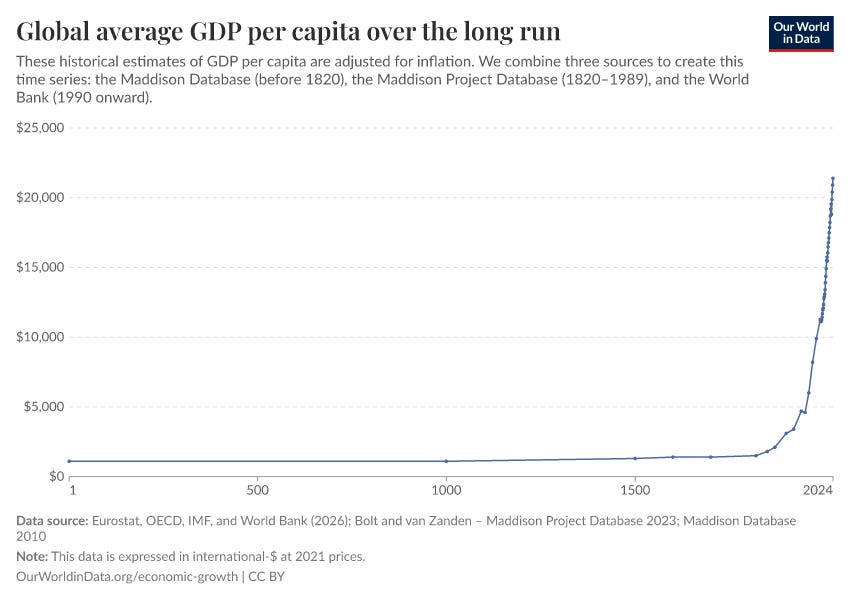
And much like the scale of GDP per capita over the last few thousand years, the total attention capture of entertainment can look a bit like the below.
Radio
Stage 1: New channel appears. Radio emerged as the first scalable electronic medium. Voices and music could travel instantly across distance. For the first time, millions of people could experience the same entertainment simultaneously without being in the same room.
Stage 2: Wider reach and audience migration. National audiences formed around shared listening habits and moments. Families gathered around radio sets in the evening. Advertisers and performers recognized radio as the primary channel for reaching mass audiences at once.
Stage 3: Standards form. Programming formats stabilized: soap operas, variety shows, news broadcasts, sports commentary. Time slots became valuable. Personalities emerged. Radio became predictable enough that advertisers could buy with confidence that people would hear them.
Stage 4: Gatekeepers consolidate. Networks and station owners controlled access to airtime. NBC, CBS, and a handful of regional operators became the gatekeepers. Advertising inventory was scarce and valuable. If you wanted to reach America, you went through them.
Stage 5: Peak financial power. Radio dominated mass attention and advertising economics through the 1930s and 1940s. By 1934, 60% of American households owned a radio. Theaters delayed their opening times until after the radio show “Amos ‘n’ Andy” ended. Margins were strong due to low distribution costs and limited competition. The radio empires seemed permanent.
Stage 6: Economics break. Television pulled attention away. Visual media offered something radio could not match. Advertising budgets shifted. Radio lost dominance but remained viable in narrower roles: cars, local markets, background listening.
Stage 7: Talent migrates. The biggest stars moved to television and film. Jack Benny, Lucille Ball, and others translated their radio success to visual mediums. Radio settled into a supporting position. It persists today, but it no longer commands the attention landscape and is mostly an afterthought.
Movies (Theatrical Film)
Stage 1: New channel appears. Film introduced recorded visual storytelling that could be distributed beyond live performance. A single production could play in thousands of theaters simultaneously. The magic of moving pictures captured the public imagination.
Stage 2: Wider reach and audience migration. Theaters spread rapidly across America and Europe. Going to the movies became a shared cultural ritual. Film became the dominant reference point for popular culture.
Stage 3: Standards form. Genres emerged: westerns, musicals, noir, comedy. Runtime conventions stabilized around 90 to 120 minutes. The star system developed, with studios cultivating recognizable faces. Production and release cycles became predictable.
Stage 4: Gatekeepers consolidate. The studio system concentrated power in a handful of major players: Paramount, MGM, Warner Brothers, 20th Century Fox, RKO. Studios controlled production, distribution, and often exhibition. Getting a film made and seen required going through them.
Stage 5: Peak financial power. Theatrical film had a long peak with two strong points. The first was 1946, when 90 million Americans went to the movies every week, in a country of 120 million. The second came decades later: the blockbuster era that began with Jaws and Star Wars in the 1970s and extended through the franchise dominance of the 1990s and 2000s, supported by home video, cable licensing (helping the television cycle), and international distribution. At its height, film commanded both massive box office and downstream revenue streams that earlier eras never had.
Stage 6: Economics break. Television provided competition from the 1950s onward. Home video shifted consumption patterns and disaggregated it. Streaming services like Netflix eventually reduced theatrical attendance frequency, as did social media time spent. Production costs rose while theatrical exclusivity windows compressed.
Stage 7: Talent migrates. Today, top creative talent works across film, television, and streaming. The distinctions have blurred. Nicole Kidman does TV now. Theatrical film remains durable and culturally significant, but it no longer exclusively defines prestige or set the rules for visual storytelling.
Television
Stage 1: New channel appears. Television brought visual storytelling into the home through broadcast infrastructure. Entertainment came directly to the living room and activated more senses than radio.
Stage 2: Wider reach and audience migration. TV became the default leisure activity for American households by the 1960s. Advertising consolidated around the new medium. Soap Operas were now TV shows, not radio shows.
Stage 3: Standards form. Seasonal schedules emerged: fall premieres, May sweeps, summer reruns. Episode formats stabilized around 22 or 44 minutes to accommodate advertising. Ratings systems developed. Genres specialized.
Stage 4: Gatekeepers consolidate. Three networks dominated broadcast: ABC, CBS, NBC. Later, cable operators like Comcast and Time Warner controlled distribution. Companies like Turner, Capital Cities Viacom and others ruled the cable universe with CNN, MTV, ESPN and more. Channel scarcity defined power. If you wanted to reach mass audiences and dominate the culture, you needed a broadcast or cable deal.
Stage 5: Peak financial power. Broadcast and cable television achieved maximum economic strength through the combination of advertising revenue and subscription fees. The cable bundle represented the greatest business model in the history of entertainment…for a while. For examples, at its peak the ESPN brand had seven channels (ESPN, ESPN2, ESPNEWS, ESPNU, ESPN Classic, ESPN Deportes, and the Longhorn Network,) even parodies in Dodgeball with the fake ESPN 8 “The Ocho”
Stage 6: Economics break. On-demand viewing weakened scheduling power. Streaming services offered alternatives to the shackles of the cable bundle. Cord-cutting accelerated. Fragmentation increased and margins compressed. Traditional TV tried to maintain its position rather than cannibalize itself, which may have accelerated its decline. Also…social media, the thief of time.
Stage 7: Talent migrates. Writers, producers, and performers now move fluidly between traditional television and streaming. The Emmys include streaming content. Television persists, but linear TV no longer dominates the attention landscape the way it did in the 1990s.

Streaming
Streaming currently sits between stages 5 and 6. It has achieved scale but faces emerging economic pressures.
Stage 1: New channel appears. Internet delivery enabled on-demand video without schedules or physical distribution. Netflix, which began as a DVD-by-mail service, pivoted to streaming and demonstrated the model’s viability.
Stage 2: Wider reach and audience migration. Audiences shifted time away from linear television toward convenience and choice. Binge-watching became a behavior. People didn’t want to wait for a new show every week they had to watch on someone else’s schedule. House of Cards proved original streaming shows could stick in viewers’ brains and be taken seriously.
Stage 3: Standards form. Binge releases, global launches, algorithmic discovery, and original content strategies stabilized. Every major media company launched its own streaming service. Playbooks emerged for what works on streaming platforms.
Stage 4: Gatekeepers consolidate. Large platforms now control subscriber relationships, viewing data, and content capital. Netflix, Disney+, Amazon Prime Video, Max, and a handful of others dominate. Independent creators and smaller studios need these platforms to reach audiences at scale and writer/directors know this is the new empire in town.
Stage 5: Peak financial power. Streaming reached scale through aggressive subscriber growth, bundling strategies, and content investment. Showrunners were made into centi-millionaires and during the zero interest rate era, streamers bought shows and content with reckless abandon. Profits didn’t matter, growth did.
Stage 6: Economics break (emerging). Growth doesn’t matter, profits do. We are watching this stage unfold now. Content costs have risen dramatically while subscriber growth has slowed. The first quarter of Netflix subscriber decline in 2022 was a watershed moment for the streaming narrative. Password crackdowns suggest market saturation. Fragmentation across multiple services creates pricing pressure and subscriber fatigue. Profitability has become the focus after years of growth-at-all-costs.
Stage 7: Talent migrates (beginning). Creators are starting to seek ownership, flexibility, and alternative distribution alongside platform work. Some are returning to theatrical for prestige. Others are exploring direct-to-fan models. The next empire is already drawing talent.

Digital (Creator Economy)
Digital entertainment is currently at Stage 3, with standards still forming.
Stage 1: New channel appears. Platforms like YouTube, TikTok, Instagram, and Twitch enabled individuals to publish and distribute content directly to consumers. Production and distribution collapsed into the same tools. Content could be made in a garage in Alabama and watched in a bedroom in Mumbai instantly. The old content of traditional media, like TV shows or movies, are clipped and used as material for the new medium.
Stage 2: Wider reach and audience migration. Harnessing the power of network effects, platforms encouraged consumers to also be creators. Audience time shifted toward creator-led and short-form content. Young audiences in particular gravitated toward creators rather than networks or studios they didn’t grow up with. Influencers became the commanding node of culture and advertisers reallocated their budgets accordingly.
Stage 3: Standards form (current stage). We are here now. Posting cadences, format conventions, monetization norms, and platform-specific playbooks are becoming legible. All media content is created with engagement and virality in mind. Repeatable creator businesses are emerging in spaces like streaming and podcast. Some creators, like Youtube’s Mr.Beast or podcasting’s Alex Cooper, have built operations that rival traditional media companies in both reach and revenue.
Stages 4-7: The rest is still unwritten.
Where will gatekeepers consolidate? Will the power law of entertainment return? Will it be the platforms themselves, talent agencies, or new intermediaries? What will peak financial power look like for the creator economy? When and how will the economics break? What comes after?
These questions remain open. The cycle suggests we will see consolidation, peak, and eventual disruption. While we are wary of attempting to “predict” the future, here is what the cycle might look like if it continues uninterrupted.
Observations and Omens
Platforms consolidate while paywalls and creator collectives steadily increase. The gatekeepers of any medium always enjoy the strongest pricing power and best margins when that medium is the primary channel of attention, with early examples being seen in Tiktok, Instagram, and Youtube. In response, more writers, podcasters, and streamers are clustering into membership-based “creator collectives” and niche networks, using tools like Substack, Patreon, and OnlyFans to pool audiences and bargaining power behind shared paywalls. Keep in mind that the real gatekeepers are whoever owns the subscriber relationship, controls the data, and can profit from the flow of attention.
Margins erode as cheaper options appear. Modern platforms are already exploring this avenue, particularly with the use of artificial intelligence. LLM’s and video-generating models pose the possibility of cutting out the need for real-life creators, lowering the cost of production and revenue sharing in order to maximize their profits. Like all mediums, the content of the new is a literal repurposing of the old, with the AI models being trained generously on datasets mined from the old digital economy.
Talent migration accelerates decline. Talent migration accelerates decline. The canary in the coal mine for any entertainment empire is where the talent goes. Lucille Ball moved from radio to television. Adam Sandler left theatrical releases for Netflix. The same pattern is playing out now: athletes and celebrities are increasingly bypassing traditional media entirely in favor of YouTube channels and podcasts. LeBron James and Serena Williams have launched production companies focused on streaming and digital. Amy Poehler started a podcast. When the stars of one medium start building in the next, the transition is already underway.
Incumbents cannibalize themselves during transitions (or fail to and suffer). Media companies that launched streaming services did so at the cost of their own cable businesses. Those that refused to cannibalize themselves got cannibalized by others, just like the Chinese refused to explore sea travel and lost their dominance to the Europeans. Platforms that refuse to embrace new methods of eyeball capture will lose their advertising dollars to the ones that do. While Meta has made investments in mediums like VR, only time will tell if these investments will pay off.
No medium goes to zero (Mostly). Instagram will still exist. Netflix will still exist. Fox News will still exist. Some will get closer to zero than the others, but loss of dominance will not mean disappearance, particularly as the life cycles of these empires continue to accelerate and overlap.
What could it all mean?
Here is the simple takeaway.
The ebbs of entertainment and the flow of attention feel like they are changing because we are in the midst of another radical transition. The Streaming Empire is maturing and facing economic pressure, while the Digital Empire is rising to challenge it. This has happened before with radio, film, and television. Exactly which empire will succeed next is impossible to answer. However, the pattern is sure. Although every empire ends, attention will always find a new throne. It is vital to look at who will be the reigning empire in the next decade and be aware that no medium is the permanent power.
Feathers For The Footnotes (Further Reading)
This piece draws on and is inspired by several thinkers and works you should check out:
Ray Dalio’s writings on economic cycles and how countries go broke provided the initial framing analogy. “The Changing World Order” and “How Countries Go Broke”
Tim Wu’s The Master Switch: The Rise and Fall of Information Empires
Clayton Christensen’s The Innovator’s Dilemma
Michael Porter’s Competitive Strategy: Techniques for Analyzing Industries and Competitors
Seth Shapiro’s Television: Innovation, Disruption, and the World’s Most Powerful Medium (The Broadcast Age and the Rise of the Network)
Fareed Zakaria’s Age of Revolutions
Jared Diamond’s Guns, Germs, and Steel
Dade Hayes and Dawn Chmielewski’s Binge Times
Taylor Lorenz’s Extremely Online
James B. Stewart’s DisneyWar
About the Authors
Bradley Andrews is a hopeful rabble-rouser on a mission to inspire the world. Stay in touch with what he’s doing outside of Mercury’s Playbook by subscribing to a weekly digest of his activity through micro.blog. This will send you writing, photos, and other curiosities that extend beyond the scope of this newsletter.
Connor Adams works across business development, content and strategy, with a focus on sports, media, and entertainment. At Wheelhouse Sports, he helps build content and media businesses around athletes and creators—developing original IP, brand partnerships, and identifying new opportunities for growth and monetization. He is currently pursuing his MBA at NYU Stern with a focus on technology, strategy, and finance. He also contributes as a humor writer to publications like Points In Case, The Weekly Humorist and more.
Fascinating framework, fellas. I love the analogy and your visual on the cycles of entertainment empires is compelling. Extending the metaphor, how would TikTok analogize today? The Mongol horde sweeping Central Asia?